
A small business consultant can stop a slow problem from becoming an existential threat. If revenue growth has stalled, cash surprises recur, a regulatory change lands on your desk, a customer-facing incident threatens reputation, a tech rollout needs market alignment or you plan to scale quickly — those are clear signals that outside help will add value. Use the checklist below to judge whether an external advisor will be faster, cheaper or safer than internal fixes.
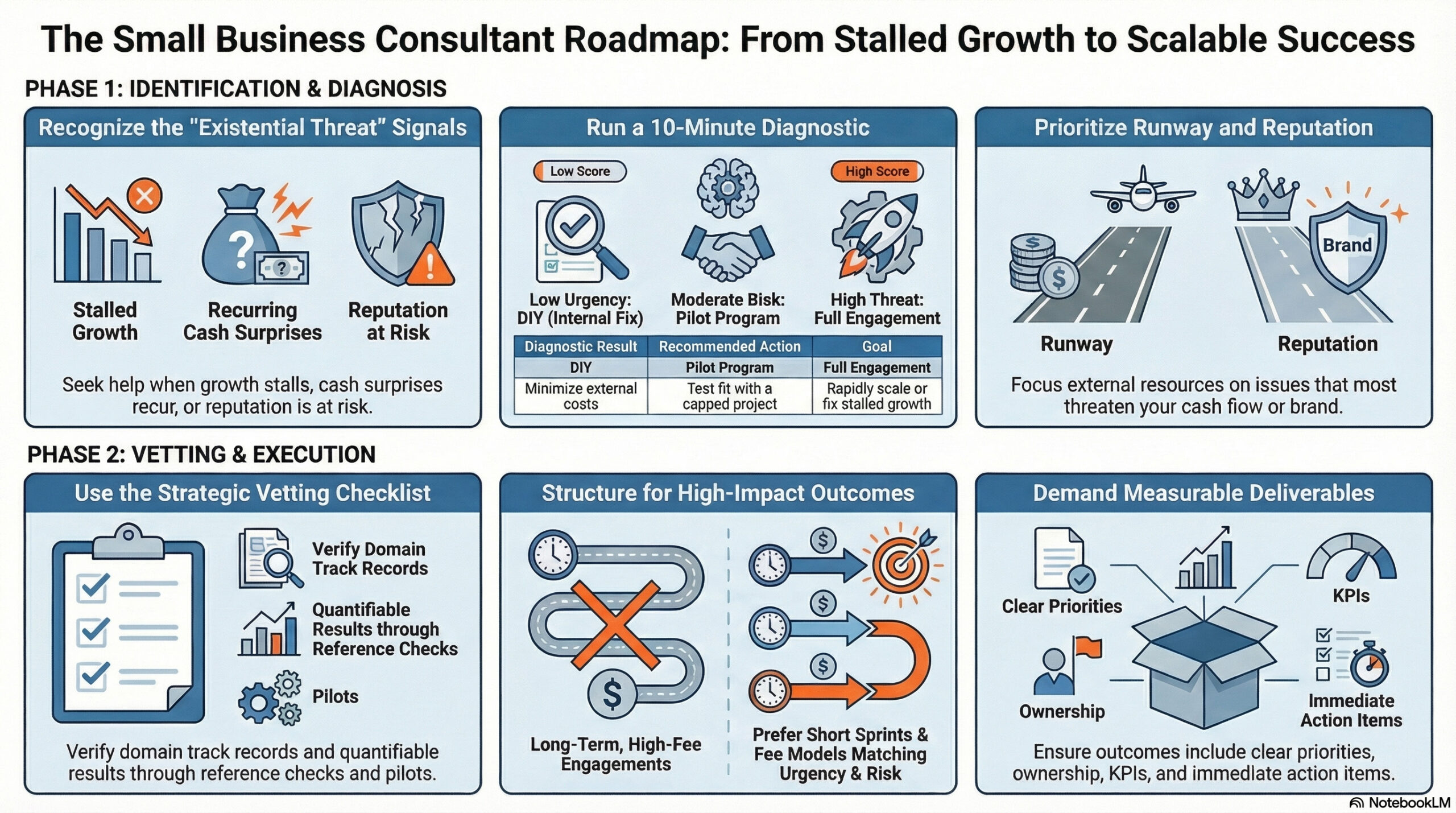
- When to hire: Bring in external help when growth stalls, cash surprises recur, regulation or reputational risk appears, a major tech rollout needs market alignment, or you plan rapid scaling. Prioritize the issue that threatens runway or reputation.
- Expected deliverables: An expert small business consultant delivers focused, measurable outcomes: clear priorities, ownership, KPIs and a short list of high-impact actions your team can execute immediately.
- Quick diagnostic: Start with a 10-minute, six-question yes/no diagnostic that scores you into DIY, pilot, or full engagement and forces an ROI view on cost of delay and payback window.
- Vetting checklist: Verify strategic clarity, relevant domain track record and quantifiable results; use reference checks and a capped pilot to test fit.
- Engagement and budget: Match fee model to urgency and risk, preferring short sprints or pilots to cap downside while proving ROI.
When to hire a small business consultant
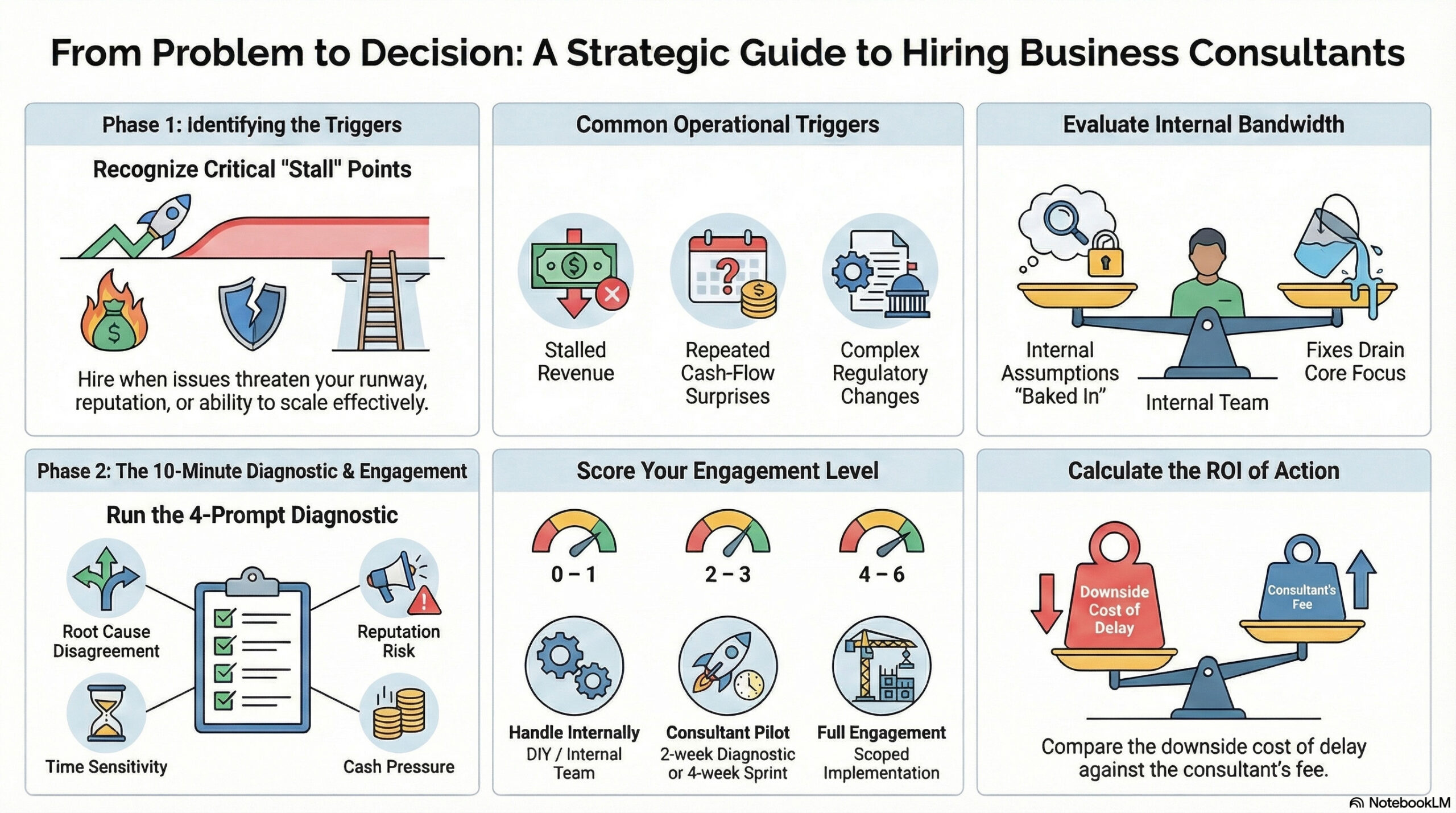
Hire when an issue threatens runway, reputation or the ability to scale. A small business consultant brings a fresh lens, targeted diagnostics and hands-on execution to shorten the time from problem to decision. That outside perspective prevents costly trial-and-error that can consume months of internal effort.
Common triggers are practical and specific — they point to work internal teams cannot resolve quickly. Below are typical situations where an external advisor produces faster, safer results.
| Trigger | What an advisor brings |
|---|---|
| Stalled revenue growth | Fresh pricing, channel or positioning tests deliver faster outcomes when internal assumptions are baked in. |
| Repeated cash-flow surprises | Short-term forecasting and treasury controls stop surprises faster than learning on the job. |
| Regulatory change | Compliance advice and messaging protect reputation and prevent fines. |
| Customer-facing incident | Reputational triage and communications reduce long-term harm. |
| Tech rollout to market | Aligning product, sales and messaging avoids poor uptake. |
| Planned scale-up | Process design and hiring plans prevent operational collapse. |
External advisors act as focused change agents when internal fixes drain bandwidth or lack objectivity. They take ownership of specific workstreams, free leaders to manage core operations, and ensure progress is measurable. That structure keeps momentum and accountability during high-risk periods.
Answer yes/no to these six prompts and score your situation.
- Are stakeholders unable to agree on the root cause?
- Is there a measurable risk to customers or reputation?
- Would a single expert reduce time to decision by more than two weeks?
- Is revenue or cash under immediate pressure?
- Does the issue require specialized compliance or market knowledge?
- Will a small pilot show results within 30 days?
The diagnostic weights reputational risk and time sensitivity above pure cost.
Compare urgency and budget using a simple ROI approach: estimate the downside cost of delay, divide by the payback window you need, and choose engagement size accordingly. Typical pilot choices cap downside while testing fit — a two-week diagnostic, a four-week remediation sprint or a scoped implementation that limits spend while proving value.
What expert consultants actually deliver
When you hire a small business consultant, expect focused outcomes rather than vague recommendations. An experienced adviser translates priorities into a short list of high-impact deliverables, assigns owners and hands over practical artifacts your team can use immediately. Good consulting turns ideas into measurable work.
| Service area | Concrete deliverable to expect |
|---|---|
| Strategy | A one-page positioning brief that aligns target customers, value propositions and pricing. |
| Finance | A 90-day cash model with scenario triggers and burn-rate controls. |
| Operations | A process map with time-savings targets and a single improvement pilot. |
| Marketing | A launch campaign plan with channel budgets, a creative brief and KPI targets. |
| Compliance | A compliance gap summary listing risks, remediation steps and owner assignments. |
Artifacts that prove value include a Statement of Work (SOW) template that sets scope and success criteria, a milestone map that commits timing and KPIs with dashboards to show progress in real time. Add a communications playbook to protect your brand during changes and clear handoff documentation so knowledge transfers cleanly to internal teams.
"How a consultant integrates with your team matters more than the label of the engagement."
Common integration modes include advisory retainers, fixed-fee projects, embedded interim management or a mixed model. Governance should include a single executive sponsor, weekly checkpoints and an explicit handoff plan.
7 traits of an expert small business consultant
Use the following seven traits as a practical interview checklist. Compare candidates against them during interviews and proposal reviews, and ask finalists for evidence that matches each trait.
1 · Strategic clarity
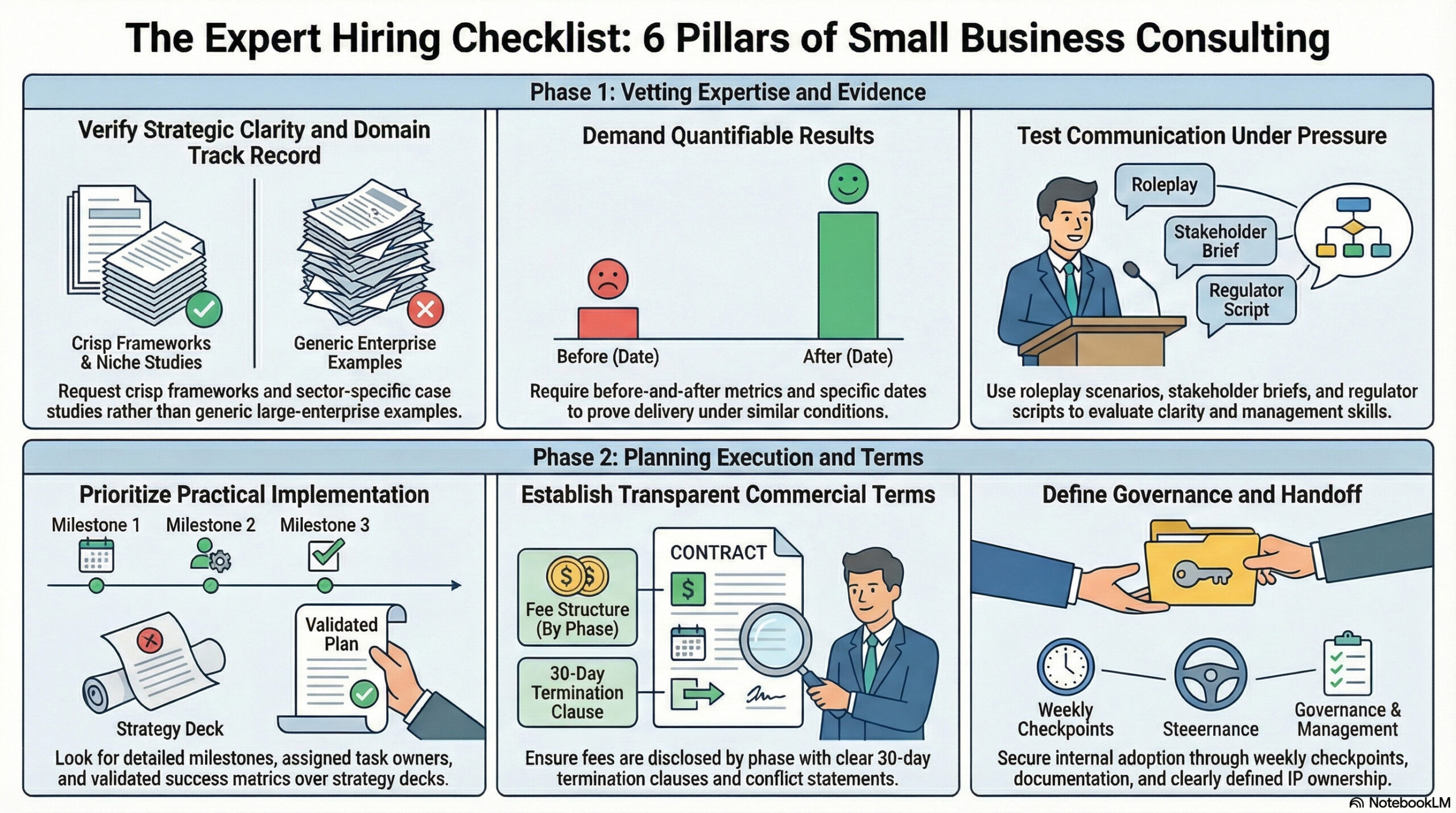
The consultant uses crisp frameworks that translate problems into prioritized actions and measurable KPIs. Ask to see the framework they would apply to your challenge.
2 · Relevant domain track record
Prefer advisors with sector experience or SME work that maps to your market, not only large-enterprise case studies. Request two case studies with context and timelines.
3 · Quantifiable results
Require before-and-after metrics, dates and the consultant's role; anecdotes are not enough. Measured outcomes show the advisor can deliver under conditions like yours.
4 · Clear communicator and stakeholder manager
The expert packages messages for customers, staff and regulators and manages expectations across groups. Test this with a two-slide stakeholder brief and a short regulator script, then roleplay a board Q&A to evaluate clarity under pressure.
5 · Practical implementation focus
Look for a plan with milestones, owners and success metrics, not just a strategy deck. The consultant should show how recommendations become tasks, who executes them and how results are validated.
6 · Transparent commercial terms
Fees should be disclosed by phase or task, with clear expense rules, conflict statements and an exit path. Trustworthy firms present ranges, success-fee options and a 30-day termination clause.
7 · Governance and handoff discipline
Expect a single executive sponsor, weekly checkpoints, a handoff plan and documentation that ensures internal adoption. Contract language that defines deliverables, acceptance criteria and IP ownership signals integrity.
How to vet and hire a small business consultant
Use a short, repeatable process for shortlist reviews and reference checks. Score candidates quickly with a 10-point vetting checklist, marking yes/no and adding a brief note for each item to compare objectively.
- Verified small business experience in your sector
- At least two verifiable client references with measurable outcomes
- Samples of relevant deliverables or anonymized case studies
- Clear process for discovery, implementation and handoff
- Communication plan and designated points of contact
- Transparent pricing and fee structure
- Defined KPIs and acceptance criteria in writing
- Conflict resolution and liability terms
- Data handling, confidentiality and regulatory awareness
- Trial option or fixed-fee pilot available
Apply a suggested weighting: experience 40%, references 30%, proposed outcomes and fit 30%. Multiply average scores by weights, sum for a final score, and select the top candidates for a paid diagnostic — aim for the top two or three, or any score above 3.8.
Trial SOW — a four-week template
Propose a compact, four-week trial SOW before any full engagement. The objective is a rapid diagnostic that surfaces priorities and quick wins.
| Week | Activity | Deliverable |
|---|---|---|
| Week 1 | Discovery — stakeholder interviews and data review | Shared risk register and key assumptions |
| Week 2 | Analysis — map Business Model Canvas blocks, highlight channels | Annotated BMC and gap list |
| Week 3 | Recommendations — draft three experiment briefs with hypothesis, metric and decision rule | 3 experiment briefs |
| Week 4 | Handoff — score experiments, pick two to run, prepare one runway test | Prioritized backlog and stakeholder sign-off |
Fixed fee range: $4,000–$12,000 depending on scope. Suggest 50% upfront and 50% on acceptance, include a straightforward NDA clause and a two-week transition plan if you proceed to implementation.
Fees, pricing models and realistic budgets
Consultants generally use four fee approaches: hourly, fixed-fee, retainer and value-based arrangements. Hourly rates provide flexibility, fixed fees limit cost uncertainty, retainers buy ongoing access and value-based contracts tie fees to outcomes.
Budget bands are directional — refine estimates after scoping assumptions about days, deliverables and required executive time. Protect your brand with contract clauses that cover confidentiality, press protocol, milestone-based payments, dispute resolution, IP and data ownership, liability caps and exit and transition planning.
Case studies, resources and next steps
LaRubie worked with an anonymized client facing an emergent compliance risk that could have triggered reputational or regulatory action. The team mapped risks across stakeholders, built a risk matrix, prepared pre-approved holding statements and trained spokespeople on tight talking points and escalation triggers.
That playbook kept messages consistent, limited speculation and helped the client retain over 90% of at-risk customers while a regulator closed its inquiry without enforcement action.
Three practical lessons from the engagement: keep a simple risk matrix tied to decision owners, pre-write holding statements for common scenarios, and run brief spokesperson training quarterly so front-line staff speak from the same page.
In a separate public example, a mid-market services firm implemented a focused CRM and automation stack that improved lead flow and avoided two new hires. From similar projects, the highest ROI typically comes from automation, role specialization and clearer sales processes.
Where to find vetted advisors
- SBA Small Business Development Centers (SBDCs)
- Local business centres and provincial small business programs
- Industry associations
- Reputable advisor marketplaces
When evaluating free or subsidized advisors, check references, conflict disclosures and sample deliverables before committing.
Why the right small business consultant matters
When growth stalls or cash surprises recur, you need someone who delivers outcomes rather than vague ideas. An expert small business consultant provides clear priorities, measurable milestones and repeatable frameworks that keep leadership aligned and accountable.
"List the three recurring problems that cost you the most time or cash — then choose the one that hurts runway or growth most."
Ready to take your next step?
Prepare a one-page brief and book a 20-minute diagnostic to test whether a targeted, framework-driven engagement will close the gap. A scoped pilot can validate the brief if the ROI and risk profile make sense.