
Hiring the right business consulting service is one of the most high-stakes decisions a growing company makes. The wrong choice wastes months and budget; the right one accelerates outcomes and builds lasting internal capability. Keep these five points front of mind — they will help you write a clear brief, compare proposals and choose a team that delivers measurable results when hiring a small business consultant.
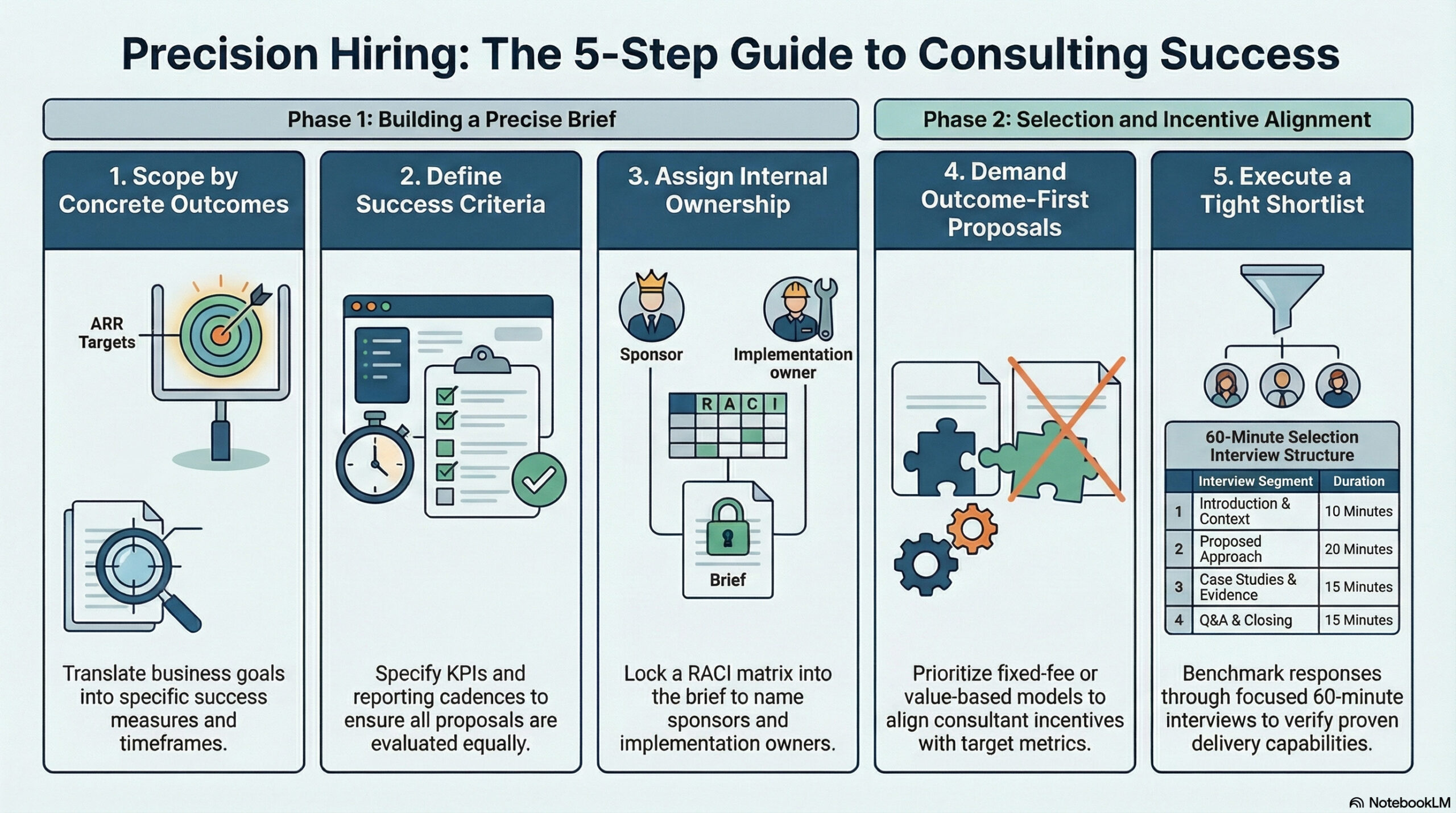
- Scope by outcome: Translate each business goal into an objective, success measures, a timeframe and required deliverables. Make the scope concrete so proposals can be compared and vendors can price risk against outcomes.
- Define success: Specify KPIs, data sources, reporting cadence and an acceptance checklist so proposals are judged on the same basis.
- Assign ownership: Name the sponsor, decision rights and implementation owners and lock a simple RACI into the brief. Internal ownership is the main predictor of consulting ROI.
- Ask outcome-first: Demand target metrics, timeframe, key assumptions and a one-sentence approach. Prefer fixed-fee or value-based models when scope is clear.
- Run a tight shortlist: Use focused 60-minute interviews, benchmark responses against the scoped brief, and pick the team with proven delivery.
Define the need: decide what you actually want from an advisor
Start with the outcome you expect and build your brief around that so your search for business consulting services is purposeful. State the core objective and capture constraints such as timeframe, budget envelope and required outcomes. Clear briefs let strategy and management consulting services respond with precise approaches instead of vague proposals.
Set measurable success criteria and guardrails before you solicit proposals so everyone knows how success will be judged. Common KPIs include:
| KPI category | Example metric |
|---|---|
| Revenue uplift | Increase ARR by X% or $Y within the engagement period |
| Efficiency improvement | Reduce order cycle by Y days or lower cost per order by Z% |
| Adoption metrics | Activation rate, retention percentage or process compliance score |
| Risk reduction | Zero compliance incidents; regulator inquiry closed without action |
Name the sponsor, decision rights and implementation owners up front to prevent handoff failure. Define a simple RACI for each deliverable and make one executive sponsor accountable for escalation. With a scoped brief, measurable KPIs and clear governance you move from proposals to predictable execution.
Types of business consulting services and what they deliver
Understanding the landscape helps you shortlist the right expertise for your situation. The three main categories cover most small-to-mid-market needs.
| Type | Focus | Typical outputs |
|---|---|---|
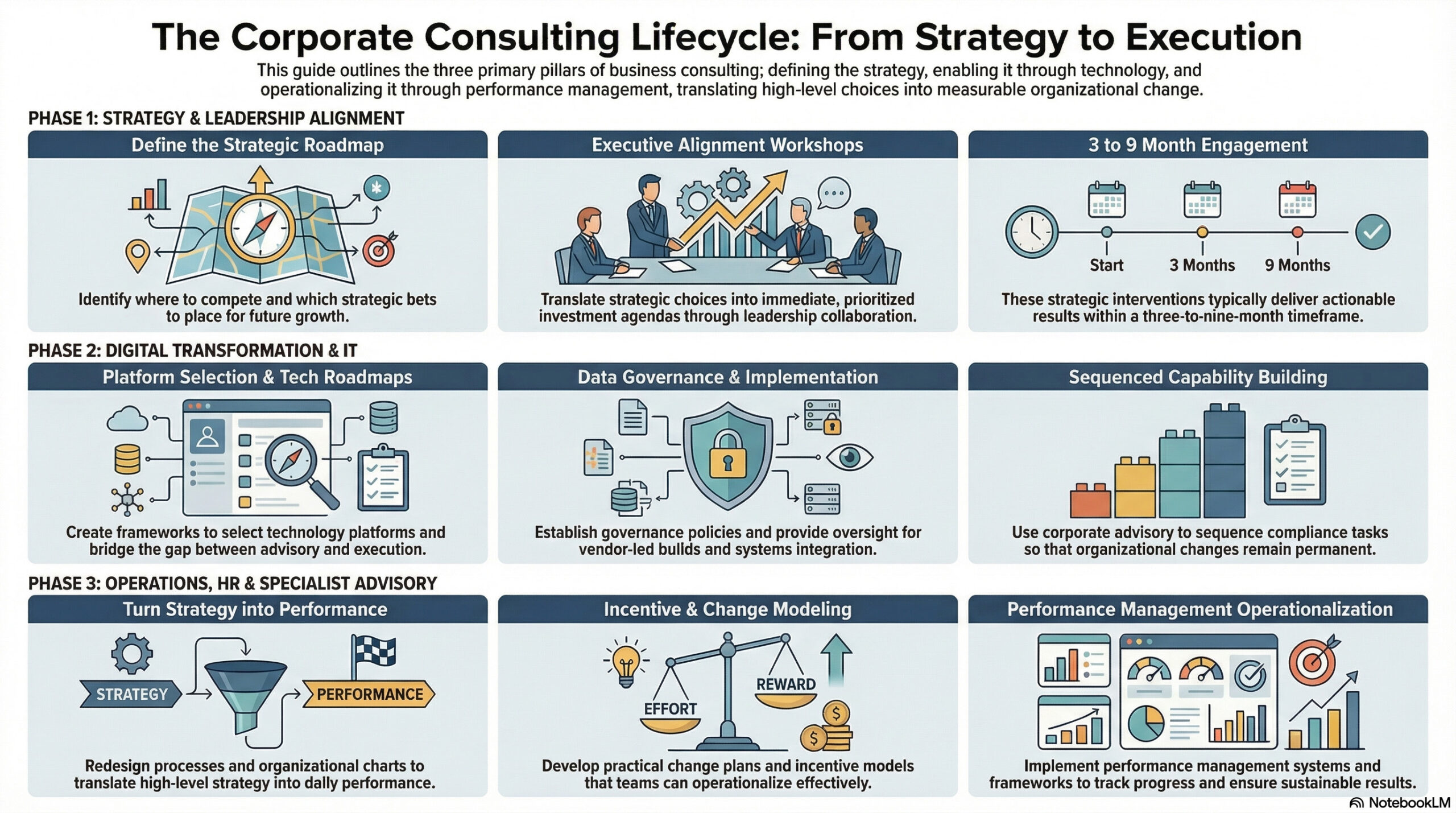
| Strategy & leadership | Where to compete and which bets to place | Strategy roadmap, pricing playbook, leadership-alignment workshops |
| Digital transformation & IT | Technology-led change, platforms and delivery | Technology roadmap, platform selection, data governance, implementation oversight |
| Operations, HR & specialist advisory | Turning strategy into performance | Process maps, org charts, incentive models, change plans |
How consulting projects run: phases, timelines and deliverables
Consulting projects follow a predictable rhythm that helps you budget time and attention. Expect a three-stage flow with clear milestones and ownership at each step — that rhythm keeps decisions evidence-based and reduces surprises.
Weeks 1–4
Outputs: assessment report, prioritized problem list and a clear hypothesis to test. Watch for incomplete data, stakeholder bias and creeping scope.
Weeks 4–12
Outputs: pilot results, an implementation plan and a quantified business case showing expected ROI. Use a short, measurable pilot to validate assumptions before scaling.
Months 3–12
Outputs: playbooks, training modules, scorecards and governance checklists. Agree on a 90-day and 180-day measurement plan to judge impact and course-correct before closing.
How much to budget and which pricing model fits
Consulting contracts usually follow one of five models. The right choice depends on how well-defined your scope is and how closely you want incentives aligned to outcomes.
| Model | Typical range | Best when |
|---|---|---|
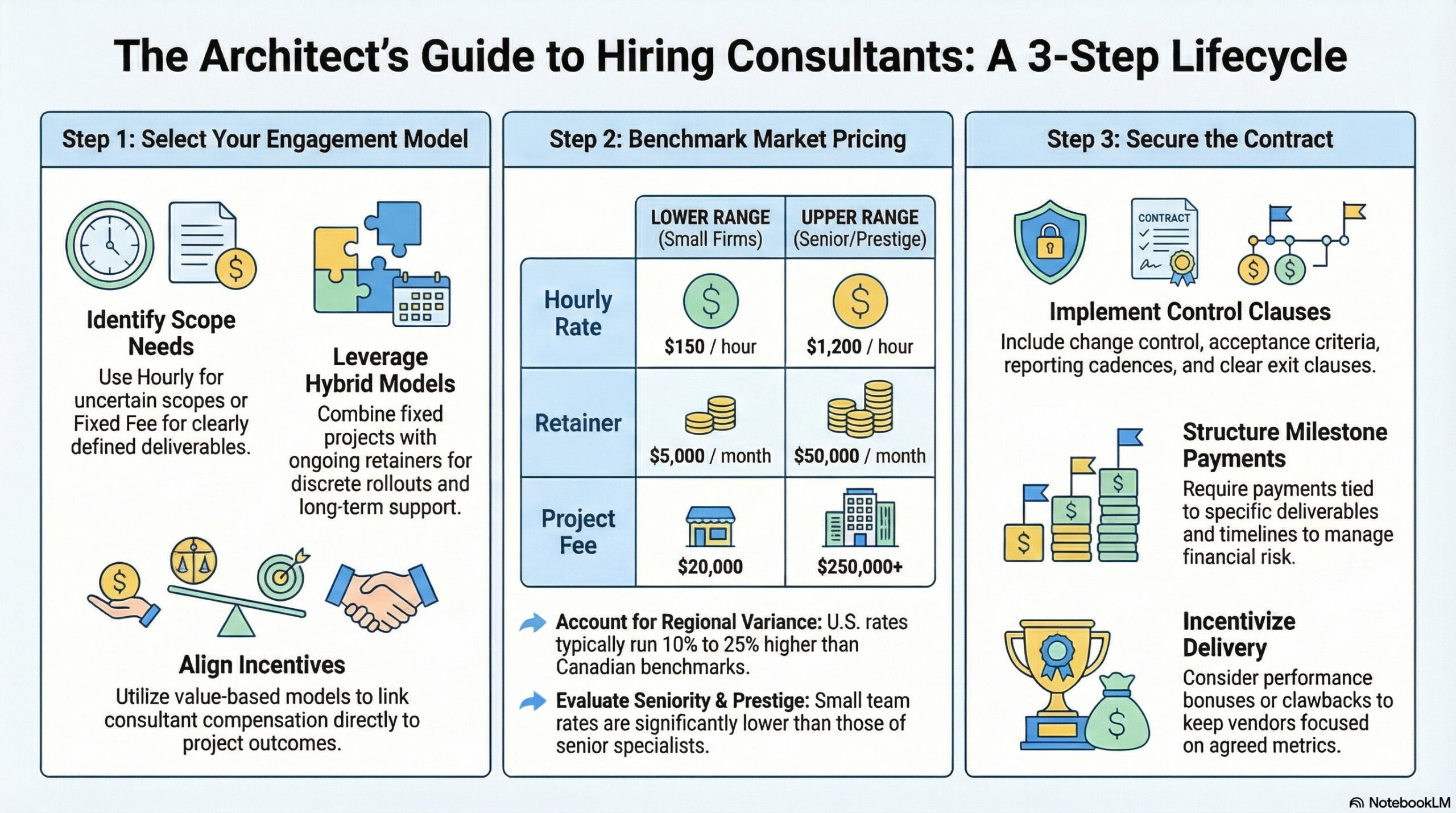
| Hourly | $150–$1,200 / hr | Scope is uncertain or exploratory |
| Fixed fee | $20,000–$250,000+ | Deliverables are clearly defined |
| Retainer | $5,000–$50,000 / mo | You need continuity and institutional memory |
| Value-based | % of outcome uplift | Outcomes are measurable and high-stakes |
| Hybrid | Fixed project + retainer | Discrete rollout plus long-term support |
Smaller consulting firms sit at the lower end of these ranges, and U.S. rates commonly run 10–25% higher than Canada. Ask for a breakdown of effort and day rates rather than a single sticker price. Protect budget with clear contract clauses: change control, acceptance criteria, reporting cadence and an exit clause. Milestone payments tied to specific deliverables keep vendors focused on delivery.
"Consider a performance bonus or clawback tied to agreed metrics — it aligns incentives and protects your investment."
The top 3 questions to ask a business consulting service when hiring
Focus vendor interviews on outcomes, people and adoption. These three areas reveal whether a firm can deliver results and make them stick.
What outcome will you deliver — and how will you measure it?
Outcome-first questions force specificity and prevent vague promises. Ask for target metrics, a timeframe, key assumptions and a one-sentence definition of success so you can compare proposals on the same basis.
Red flags: answers that reference activities rather than results, vague language like "improve performance" without a number, or an inability to name the baseline they'll measure against.
Who will actually do the work — and what is their track record?
Execution depends on people and availability more than on slideware. Request bios for named team members, a recent similar case study and contactable references, along with time allocations for each staff member.
Red flags: unclear delivery ownership, rotating staffing, or wholesale subcontracting without clear oversight.
How will you ensure capability transfer and sustained use?
Probe for training cadence, change-management steps and governance checkpoints so outcomes stick after the consultants leave. Expect a transfer plan with embedded coaching and scheduled governance reviews.
Ask how the team will measure adoption over time. Strong answers include all three of the following:
Benchmarked metrics measured at agreed intervals and compared to baseline KPIs — objective proof that changes are taking hold.
Training logs and completion rates including follow-up coaching or certification milestones. Completion alone is insufficient without evidence of behaviour change tied to performance metrics.
Governance sign-offs and operating procedures handed over, with clear roles for ongoing ownership and escalation. Documented checklists and regular reviews show the organization can sustain the change.
How is risk shared and priced?
When outcomes are measurable, request value-based or pay-for-performance options and a sample contract clause so you can validate the math. Insist on a clear success calculation, a fee cap and a clawback where appropriate to protect the client and align incentives.
Shortlist, interview and select: a simple vendor process
Run a focused 60-minute vendor interview structured to surface evidence at each stage.
| Time | Segment | What to judge |
|---|---|---|
| 0–10 min | Introductions | Clarity and relevance of positioning |
| 10–30 min | Client case and proposed approach | Evidence quality and methodology |
| 30–45 min | Team composition and references | Team fit and reference strength |
| 45–60 min | Commercial terms and next steps | Commercial logic and incentive alignment |
Scoring proposals: a weighted matrix
Score proposals with a simple weighted matrix, then adjust weights to prioritize what matters for your specific project.
LaRubie worked with a mid-market Canadian professional services firm to rebuild its go-to-market motion. The engagement included discovery, messaging and pricing redesign, sales enablement, a pilot program and a retainer for rollout.
The client recorded a 25% revenue increase in nine months, with pre/post KPIs confirming the impact.
Key hiring lessons from that work: prioritize demonstrable outcomes over credentials, insist on a named team with relevant experience, and test with a small paid pilot before scaling.
Hire business consulting services with confidence
Start with a one-page scoped brief that converts a single business goal into measurable outcomes, two constraints and a target timeline. Then schedule a 30-minute intake with LaRubie to review the brief, validate fit and confirm a phased workplan with clear deliverables.