
Strategic planning for small business doesn't have to mean a week of spreadsheets and meetings. You can create a focused, one-page plan in a single session that turns strategy into work your team can actually execute. This article walks through a six-step process — from mission to 90-day action plan — and gives you a template you can use right away straight from small business consultant desktop.
- One-page plan: Build the six-step framework in a focused 90-minute session so big ideas convert into daily work.
- Priorities & KPIs: Choose three to five priorities that match your competitive advantage and the team's capacity, then assign simple KPIs so success is visible.
- 90-day projects: Break each priority into 90-day projects with clear milestones and a single empowered owner.
- Aligned workshop: Run a half-day session with four to eight execution leads, use pre-work, and secure commitments on owners, scope and resourcing.
- Quarterly reviews: Hold 60–90 minute reviews that start with KPIs, escalate red projects, and decide on scope or resource shifts.
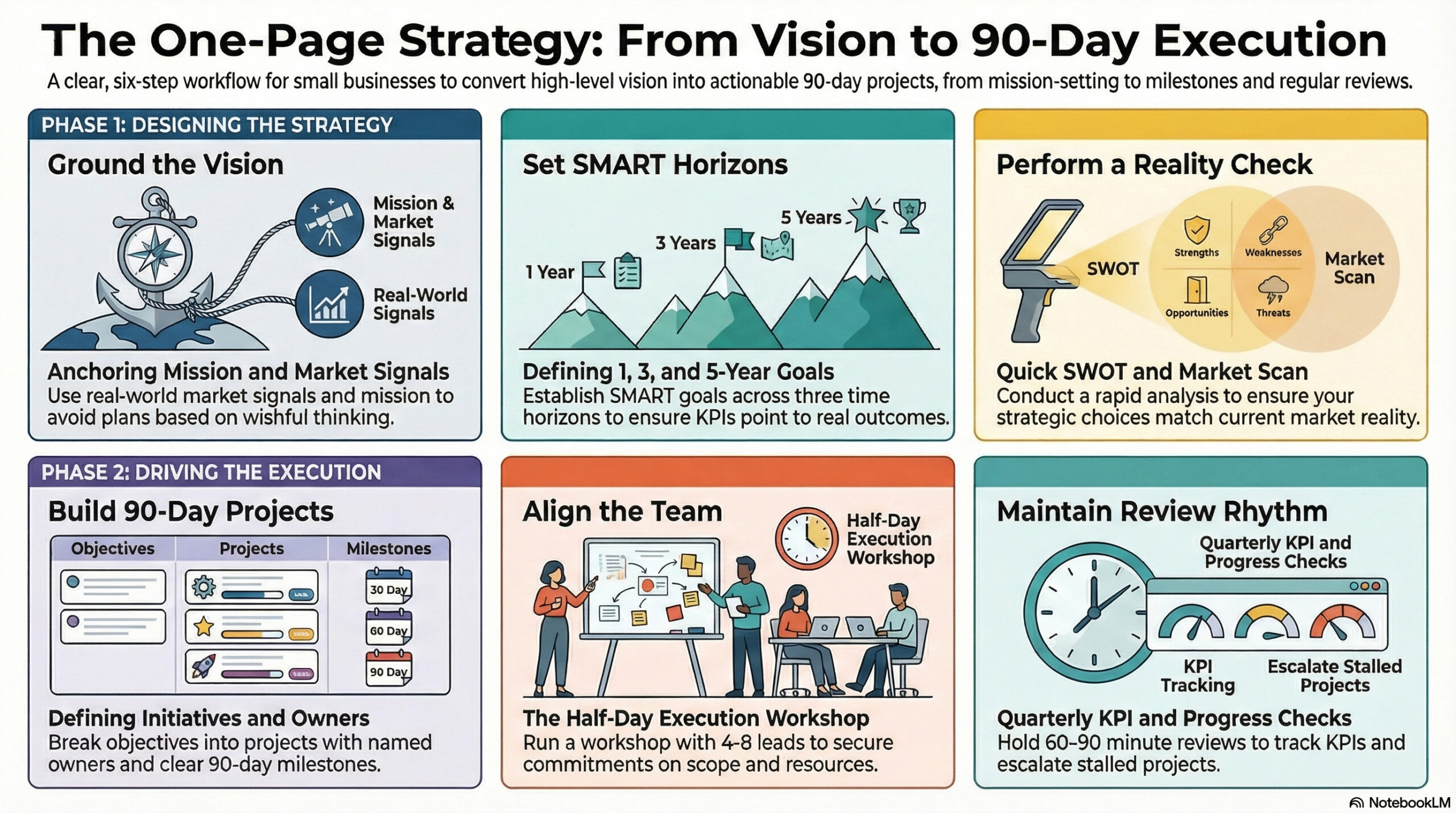
Tip 1 — Build a one-page plan in six practical steps
Start with a compact framework that links mission, market signals and measurable priorities. The goal is a one-page plan you use every quarter — not a document that collects dust. Keep the template close so the plan evolves as performance data comes in.
Clarify your foundation
Define who you serve, the problem you solve, and what success looks like in three years. Capture mission, vision and values in the template so future decisions can be checked against them. Keep these statements short and specific.
Set horizon goals
Translate purpose into SMART objectives for one-, three- and five-year horizons. Give each objective a leading indicator so you can spot progress or risk early. Use consistent language across the plan to avoid ambiguity.
Select your priorities
Choose three to five priorities that align with your advantage and the team's capacity. Focus effort on the few initiatives that will move the needle — treat everything else as lower priority or an experiment backlog.
Test context with a quick SWOT
Run a 15–20 minute SWOT and a quick market scan focused on competitor moves, customer signals and two trends that could shift your priorities. Log findings in the template so choices match reality, not wishful thinking.
Design your initiatives
For each objective, define one to three initiatives and break them into projects with clear owners. Assign a single success metric to each project. Keep scope tight to allow rapid learning and adjustments within the quarter.
Lock the cadence
Group projects into a 90-day action plan and agree on weekly check-ins plus quarterly reviews. Make the one-page template the working source of truth and update it live. A clear review rhythm ensures learning drives the next planning cycle.
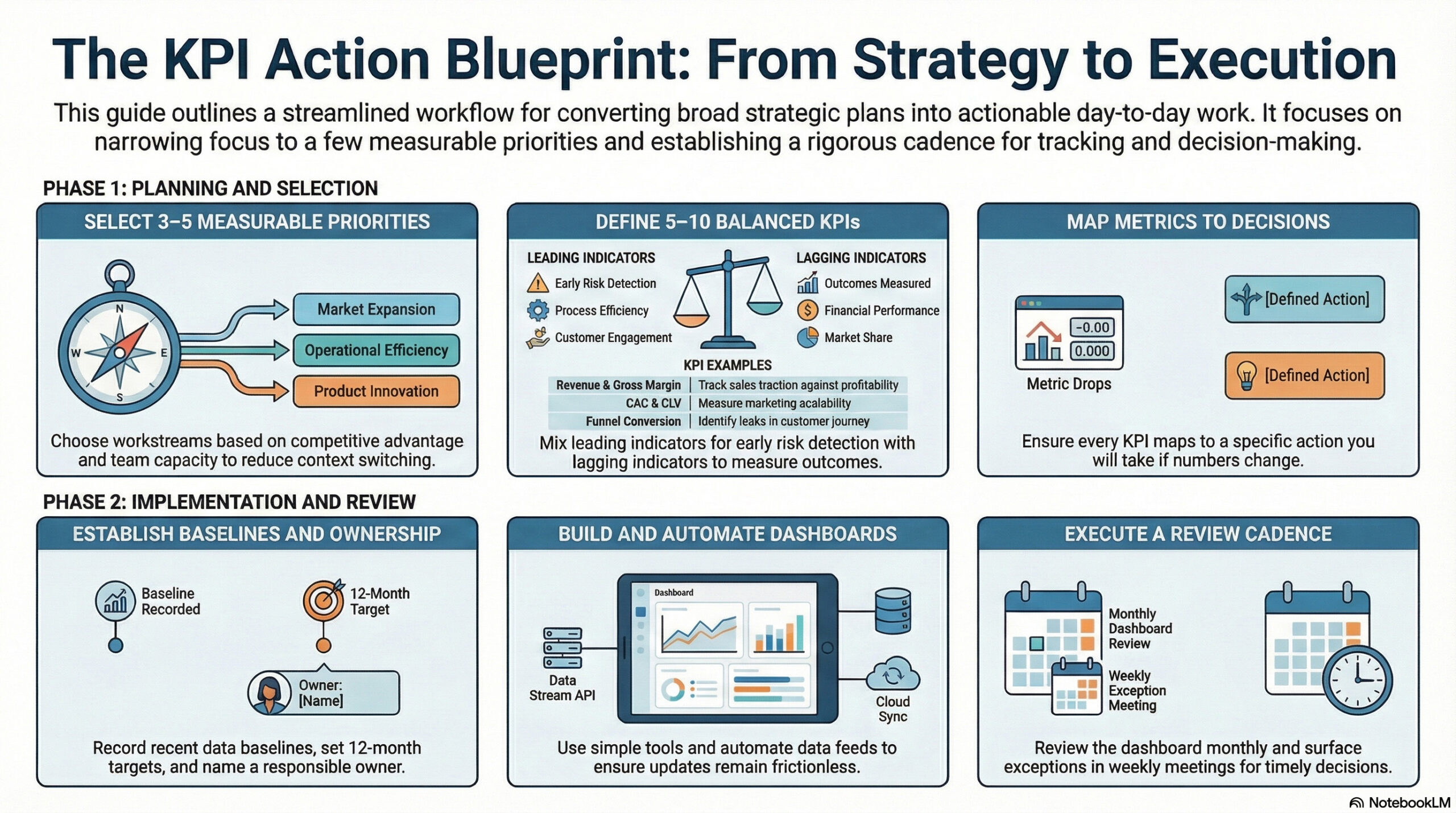
Tip 2 — Choose 3–5 measurable priorities and KPIs
Select a compact set of workstreams you can finish this year. Narrowing focus reduces context switching and helps convert the strategic plan into day-to-day work rather than a wish list. Aim for five to ten KPIs in total, mixing leading indicators that surface risks early with lagging indicators that show outcomes.
"Avoid vanity metrics — every KPI should map to a decision you will actually make if the number changes."
Revenue growth rate
Track period-over-period revenue to see whether sales initiatives gain traction. Link changes directly to specific projects.
Gross margin %
Watch margin to ensure growth doesn't come at the expense of profitability. Tie changes to pricing, product mix or cost initiatives.
Customer acquisition cost
Measure acquisition spend per new customer to understand scalability. Use CAC trends to decide whether to double down or pause channels.
Customer lifetime value
Estimate long-term customer value to prioritize retention and upsell work. Compare CLV to CAC to test whether the business model scales.
Conversion rate
Track conversion at key funnel stages to spot leaks in the customer journey. Use findings to prioritize product or experience fixes.
Churn / retention rate
Monitor retention alongside conversion — a full picture of the customer journey prevents growing into a leaky bucket.
Record a recent baseline for each KPI using last quarter's data, set realistic six-to-twelve month targets, and name the owner responsible for moving each metric. Build a simple dashboard in Google Sheets or your existing tool and automate one or two data feeds where possible so updates are frictionless.
Tip 3 — Turn priorities into a 90-day action plan with owners
For each priority, list the projects that will deliver it and define clear milestones. Assign a single owner who has the authority to make trade-offs, plus a backup to escalate. Scope projects to a 90-day horizon so teams get rapid feedback and visible momentum.
Deliver one or two fast wins to build confidence. Capture baselines for every KPI and confirm project owners and decision rights.
Run the main workstreams. Hold weekly check-ins to surface blockers early and surface any scope or resource conflicts before they compound.
Review KPIs against targets. Decide what to continue, adjust or stop. Prepare the brief for the next 90-day cycle so momentum is unbroken.
Use a simple accountability matrix instead of long role descriptions: owner, backup and supporting contributors. Include one or two quick wins deliverable in the first 30 days to build confidence and show the plan produces results. Run a brief resource and budget check before kick-off and capture projects, milestones, owners and the single success metric in a shared template for recurring review.
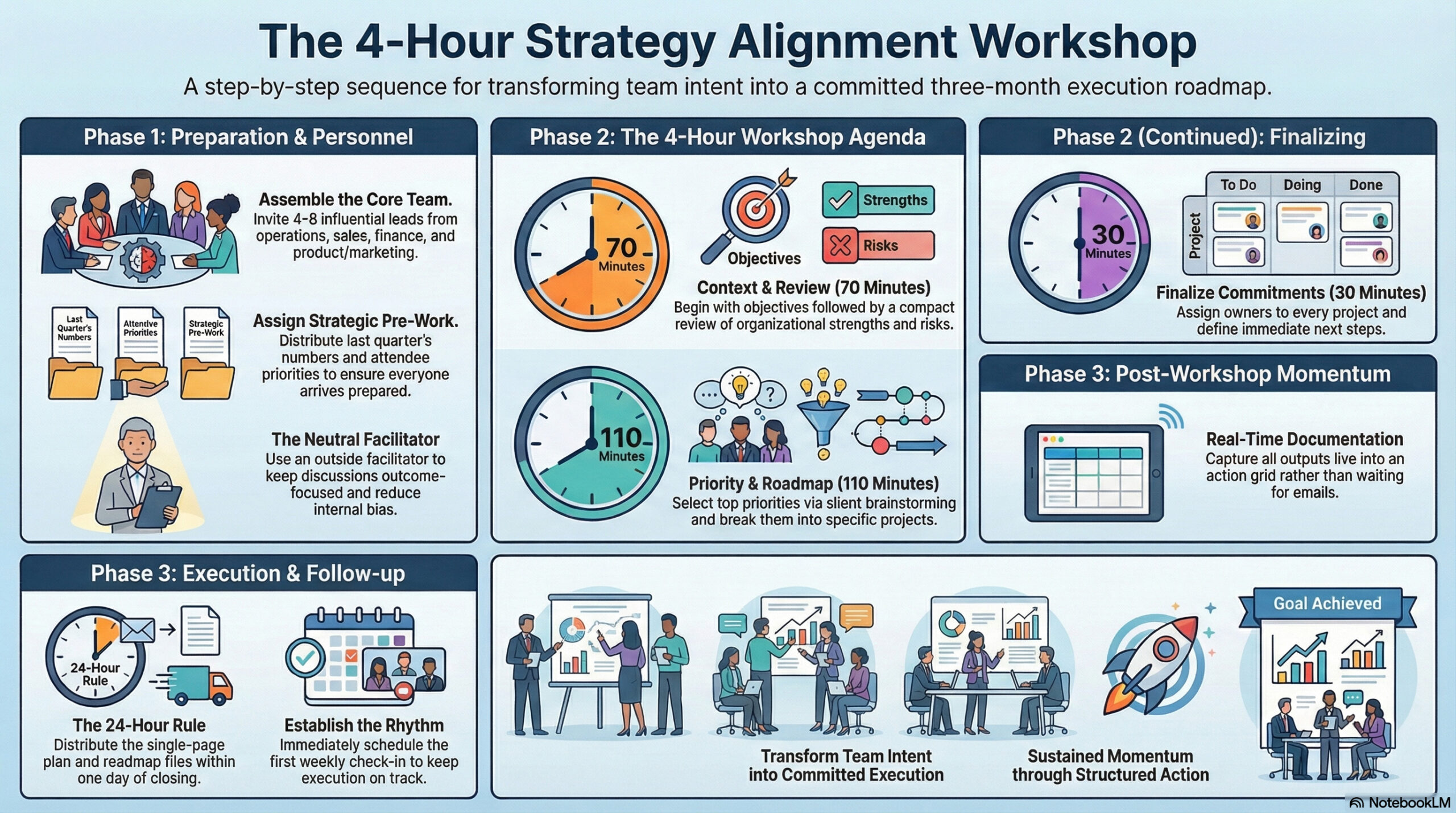
Tip 4 — Run a focused half-day workshop to align the team
Invite four to eight people who directly influence execution: the owner plus leads for operations, sales, finance and either product or marketing. Send pre-work that includes last quarter's numbers and a short priority from each attendee so everyone arrives prepared. A focused half-day workshop is the fastest way to turn intent into executable commitments.
| Time | Activity | Output |
|---|---|---|
| 0–30 min | Context and objectives | Shared understanding of the current situation and goals |
| 30–70 min | Strengths and risks review | Refined SWOT with ranked priorities and blockers surfaced |
| 70–120 min | Priority selection | Three to five agreed priorities with rationale and constraints |
| 120–180 min | Three-month roadmap build | Projects, milestones and success metrics for each priority |
| 180–210 min | Owner assignment and next steps | Populated one-page plan and first weekly check-in booked |
Time-box activities, use silent brainstorming to reduce loud-voice bias, and vote to surface top options quickly. Bring a neutral facilitator when possible so discussions stay outcome-focused, and capture outputs live into an action grid so nothing lives only in email. Distribute files within 24 hours and schedule the first weekly check-in to keep momentum.
Tip 5 — Execute, review quarterly and avoid the common traps
Hold a focused 60–90 minute quarterly review that prioritizes decisions over status updates. Start with your KPI dashboard, escalate any red projects, and decide whether to change scope or reallocate resources. Common failures are predictable — and preventable — when you set simple guardrails.
Vague goals without owners
Every priority needs one accountable person with the authority to make trade-offs — not a committee. Record owners and decision rights in the shared template so there's no ambiguity at review time.
Too many priorities, too little focus
Limit execution to two to four projects that will materially move the business. Reserve other ideas for an experiment backlog. Narrowing work reduces context switching and increases the chance you finish commitments.
Metric overload
Track three meaningful metrics and one health metric per project. Avoid vanity metrics and ensure each KPI maps to a decision you will make if it changes. Use the dashboard to trigger those decisions — not to report activity.
Misaligned resources
Give each priority owner a small budget line so they can act without constant escalation. Misaligned resources are the single fastest way to stall a plan that looked great on paper.
A local startup had strong product work but no planning rhythm. In a half-day workshop LaRubie created a one-page plan, a 90-day roadmap and a simple KPI dashboard, then coached weekly check-ins through the first quarter.
After 90 days they had launched a prioritized pilot, won early customers and produced a hiring plan. The new cadence reduced firefighting and increased decision speed across the whole team.
Turn strategy into measurable action — this week
Strategic planning for small business works when choices are compressed into clear, executable work. The real shift happens when priorities become a 90-day action plan with named owners and visible metrics — that's what creates accountability and predictable momentum.
Here's what to do before the end of the week:
Block 90 minutes to complete the six-step one-page plan. Use last quarter's data as your baseline.
List your top three priorities with a simple KPI and a named owner for each.
Build your 90-day action plan using the three-phase roadmap: quick wins, core execution, measure and reset.
Schedule the first 14-day check-in to remove obstacles and keep progress visible before momentum fades.
Want an outside facilitator for your first session?
LaRubie supports first planning cycles with a template pack, facilitated half-day workshops and short coaching retainers. A compact half-day plus a 90-day sprint delivers alignment and measurable execution for teams that need structure quickly. Download the template pack or book a short consult to get started.