
Many people assume a small business consultant delivers quick fixes. The real role is far more layered — combining diagnosis, facilitation and delivery in a steady rhythm that creates measurable, lasting results. This article breaks down the five key roles, walks through a typical day, and gives you a clear picture of what to expect from a firm or an independent consultant before you hire.
- Daily rhythm: Consultants balance diagnosis, facilitation and delivery — splitting time between interviews and analysis, alignment workshops, and synthesis mapped to the next deliverable. This cycle repeats across discovery, design and handover phases.
- Core deliverables: Concise, adoption-focused artifacts including diagnostics, options papers, roadmaps, KPI packs and playbooks that teams can actually use.
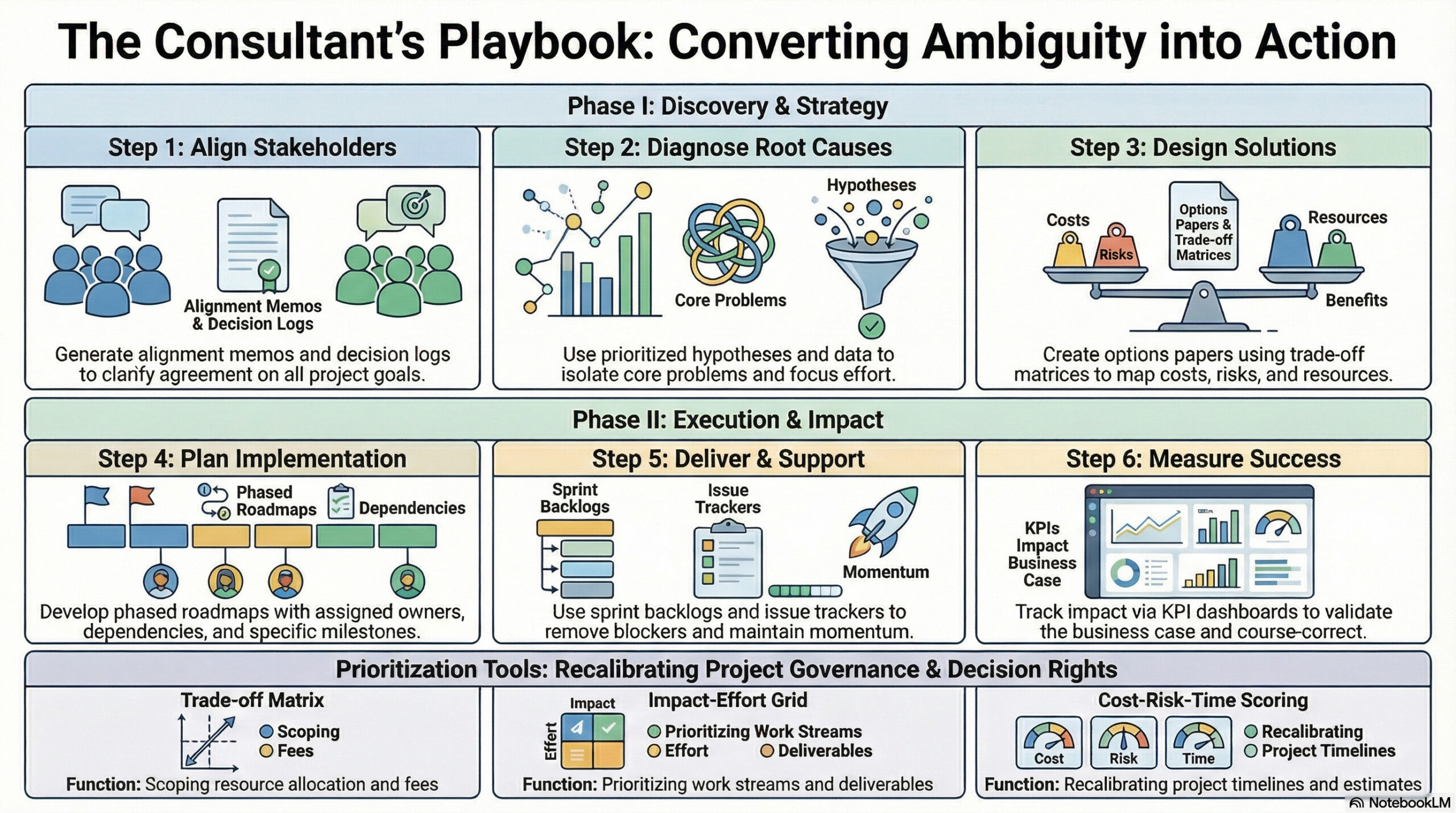
- Repeatable framework: Align → diagnose → design → plan → deliver → measure converts ambiguity into decisions and outcomes, with built-in checkpoints for scope, budget and timelines.
- Fees and budgeting: Expect hourly, daily, fixed-project or retainer models. Price reflects experience, niche expertise and local market rates — not just hours.
- Hiring triggers: Engage when expertise, bandwidth or decision alignment is missing. Start with a scoped 30–90 day diagnostic to test fit and demonstrate early impact.
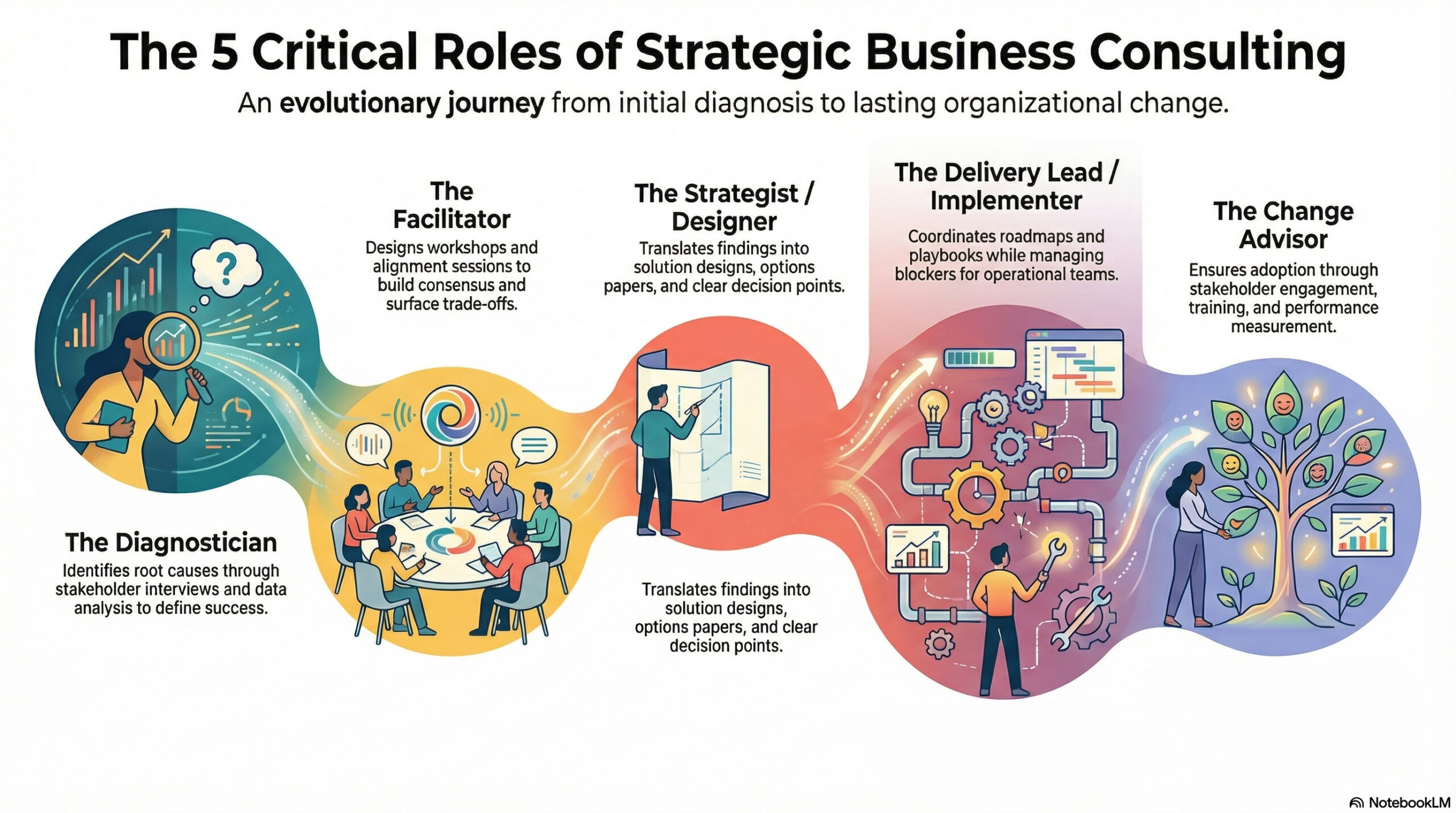
Five key roles of a business consultant
A skilled consultant wears several hats across a single engagement. Understanding each role helps you set the right expectations, ask better questions during hiring, and get the most from the relationship once work begins.
Diagnostician
Conducts stakeholder interviews, data analysis and root-cause work to identify issues, prioritize hypotheses and define success criteria before any recommendations are made.
Facilitator
Designs and runs workshops and alignment sessions that surface trade-offs, build consensus and capture decisions across stakeholders who may not otherwise agree.
Strategist & Designer
Turns diagnosis into options papers, trade-off analyses and solution designs with clear decision points and resource implications — so leaders can choose with confidence.
Delivery Lead
Produces roadmaps, sprint backlogs, models and playbooks, manages blockers and coordinates handover to operational teams so recommendations don't stall at the slide deck.
Change Advisor
Manages stakeholder engagement, training, governance and measurement so recommendations are adopted and performance improves — long after the engagement formally closes. This is the role that separates transformative engagements from ones that collect dust on a shelf.
A day in the life: what the work actually looks like
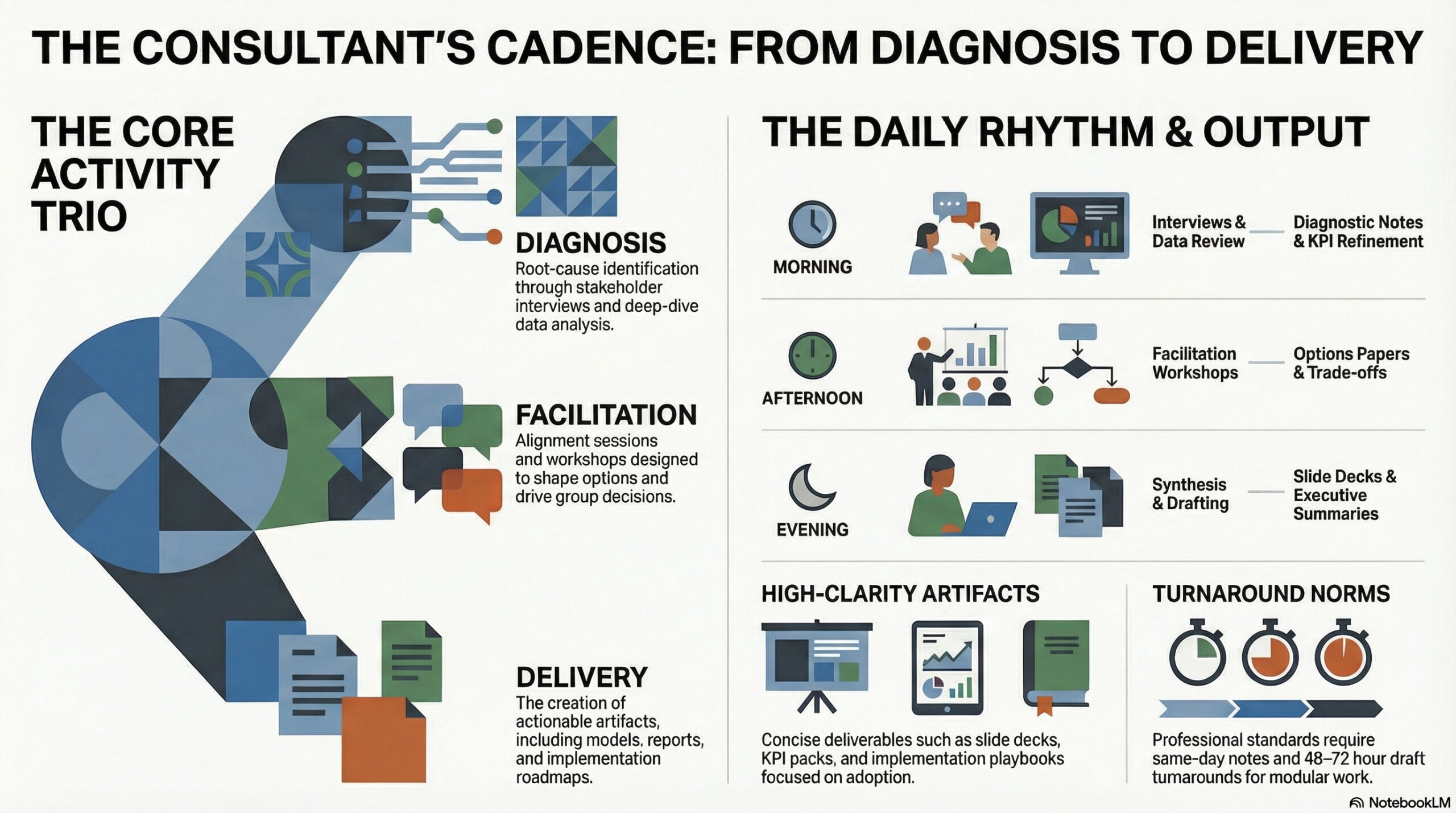
A business consultant divides the day among diagnosis, facilitation and delivery. The time split shifts by phase — discovery weeks emphasize diagnosis, implementation phases demand more delivery and support. Here's what a typical day looks like in practice.
Stakeholder interviews & diagnostic notes
Back-to-back interviews surface assumptions, blockers and root causes. Notes are captured live and fed directly into the day's diagnostic work.
Data review & KPI refinement
Data pulls and model reviews refine assumptions for KPI packs. This is where the numbers either confirm the hypothesis or force a pivot before the afternoon session.
Workshop facilitation & options development
Workshops generate options and trade-offs. The consultant's job is to keep decisions moving — not to advocate for a specific outcome, but to make the trade-offs visible.
Synthesis & next-day slide draft
The day's insights are synthesized into a working draft. Same-day notes, 48–72 hour turnarounds for small modules, and staged delivery for larger packages keep decisions moving at the required pace.
"Facilitation and synthesis make recommendations executable rather than theoretical — that's where consulting value is really created."
Core competencies: what clients should expect
Clients expect both technical depth and advisory presence. Technical fit and measurable impact matter most — clients hire for outcomes rather than certificates alone. Here's what strong output looks like across the five functional areas.
| Area | What strong output looks like |
|---|---|
| Strategy | Current-state assessments, options papers with trade-offs, and roadmaps that include decision points and milestones. Good strategy work clarifies where to invest and what to stop doing. |
| Operations | Process maps, RACI charts, operating cadences and implementation plans that reduce cycle time and variability — tying daily behaviors to strategic goals. |
| Finance | KPI packs, baseline models, cost-benefit analyses and impact projections used for budgeting and forecasting. Clear financial scenarios show trade-offs and the expected timeline for ROI. |
| Marketing | Commercial diagnostics, segmentation and go-to-market roadmaps tied to revenue levers and experiments — connecting tests and metrics to measurable revenue outcomes. |
| HR | Org-design recommendations, role profiles, training curricula and change-support plans that reduce implementation risk by clarifying ownership and incentives. |
Interpersonal skills determine whether those outputs become action. Stakeholder management, facilitation, influence and crisp writing win alignment. Ask for baseline metrics, agreed success criteria and before/after KPI reports tied to the engagement — those items make it easy to measure whether the consultant delivered the promised impact.
The framework: how consultants convert ambiguity into outcomes
A simple playbook converts ambiguity into action. Each step produces a concrete artifact — and measurement feeds back into scope, budget and timeline decisions so estimates remain living commitments rather than one-time guesses.
Documents who agrees to what and when — making implied alignment explicit and preventing revisited decisions later.
Supported by data, this isolates where to focus effort first and prevents the team from solving the wrong problem.
Highlights decision points and the resources each option requires so leaders choose with their eyes open.
Assigns responsibility and sets realistic timelines. Dependencies are visible before they become blockers.
Keep momentum and enable governance as work unfolds. Delivery artifacts remove blockers before they stall the project.
Identifies course corrections and validates the business case. Measurement feeds back into the next planning loop.
Fees and pricing: how consultants charge and how to budget
Consultants commonly use four fee structures. The right model depends on how well-defined your scope is and how closely you want incentives aligned to outcomes.
| Model | Typical range | Best when |
|---|---|---|
| Hourly | $75–$600+ / hr | Scope is uncertain or exploratory; independent or small-firm work |
| Daily rate | ~8× hourly rate | Short, focused sprints with a clear day's output defined |
| Fixed project | $5,000–$1M+ | Deliverables are clearly defined and scope risk is manageable |
| Retainer | $3,000–$10,000+ / mo | Ongoing advisory, institutional memory and continuity |
| Value-based | 10–25% of outcome | Outcomes are measurable and the consultant materially accelerates revenue or reduces cost |
Example: A project costs $60,000 and yields $240,000 annually. Monthly benefit = $20,000. Payback = 3 months. If that math works for your situation, a focused engagement is almost certainly worth it.
When to hire — and what to watch out for
Bring in outside help when internal teams lack specific expertise, bandwidth is constrained, or decisions are stalled and politicized. Clear hiring triggers include a short public deadline, regulatory or reputational risk, or a missing analytic capability your team can't build fast enough.
There is no clear internal owner for a priority outcome
Stakeholder conflict is escalating and internal alignment has stalled
A short deadline under public scrutiny requires outside credibility
The work carries regulatory or reputational risk beyond internal expertise
An analytic or functional capability is missing and can't be built in time
Red flags to watch for in interviews
Vague deliverables — no specifics on what will be handed over or when
No references or an unwillingness to provide contactable past clients
Refusal to include termination-for-convenience terms in the contract
Evasive responses on fees, team composition or subcontracting arrangements
Three interview questions that reveal everything
| Question | What you're really testing |
|---|---|
| "How will you measure success?" | Whether they think in outcomes or activities — and whether they can commit to a number |
| "Who will do the work day-to-day?" | Whether the senior person who sold the work will actually be present during delivery |
| "Describe a similar risk you managed." | Whether they have genuine relevant experience or are adapting a generic framework to fit your situation |
Ready to see what a consultant can do for your business?
If you face strategic or reputational decisions this quarter, list the three biggest items and assign an owner for each — then schedule a 30-minute diagnostic with LaRubie to test one decision and see a practical action plan. LaRubie offers disciplined frameworks for clarity and structure in complex, regulated and high-stakes environments, serving clients across Canada with North American reach.